
Treatment Approaches
Retrofitting
Retrofitting refers to the upgradation or improvement of existing toilet containment systems such as single pit latrines and septic tank-based toilets. In many rural areas, toilets already exist but are poorly designed or not suitable for safe fecal sludge management. Retrofitting is therefore an important approach to ensure that these existing systems function safely and support proper FSM.
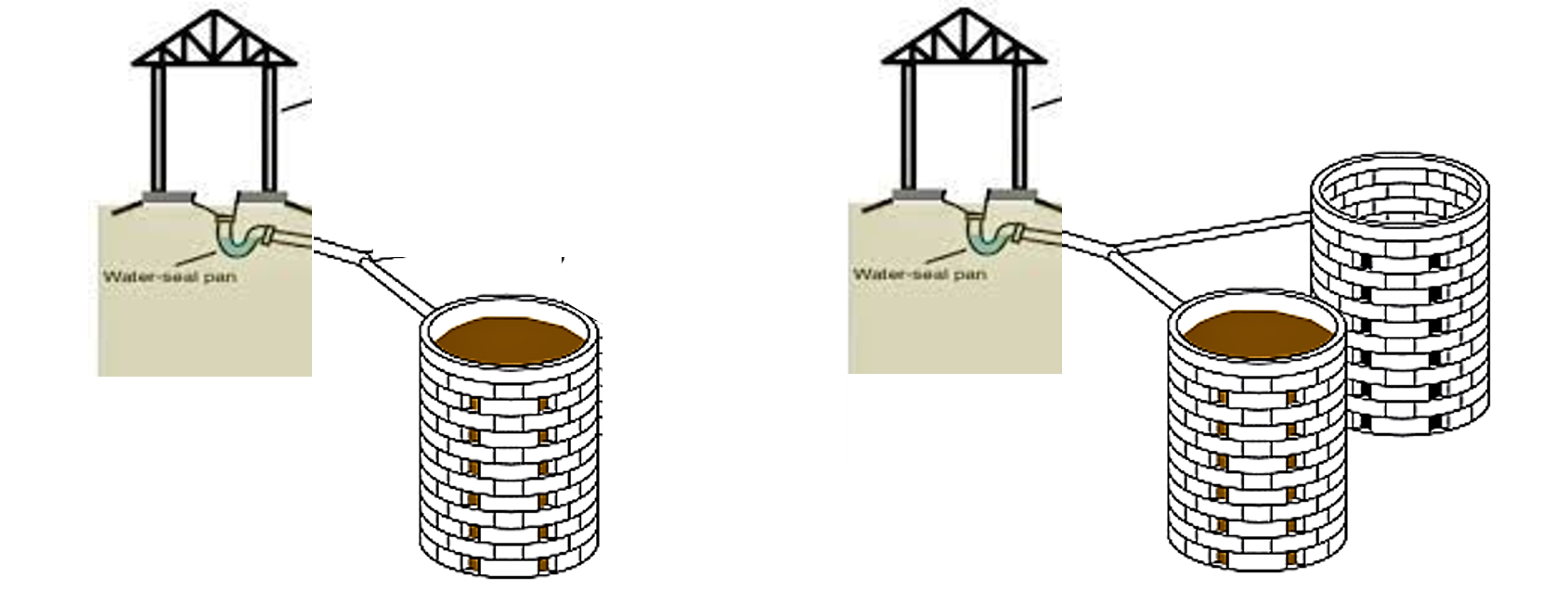
Provisions for retrofitting toilets:
- Converting single pit latrines to twin pit, by adding an additional pit
- Correcting defective septic tanks (e.g. adding the chamber separation wall, sealing the bottom)
- Improving twin pits (e.g. ensuring functional junction chamber, honeycombing or perforations in pit wall, adequate distance between pits, safe distance from water sources)
- Installation/retrofitting of alternative twin pit diversion mechanisms which are easy and safe to install and use, for example SATO V-trap connection system
- Improving technologies and replacing leach-pit latrines with appropriate technologies in challenging geographies such as high-water table, rocky areas (example bio toilets, composting toilets, raised toilets)
Challenges:
- Un-availability of land at households, acceptance by households, expenses for reconstruction, etc., with this approach
Note
Retrofitting is not suitable as a treatment approach in urban areas.
Co-Treatment at Existing STPs
Key takeaway
STPs operating below capacity should be shortlisted for co-treatment using a technical checklist.
Leverage existing wastewater treatment infrastructure for cost-effective treatment of fecal sludge through integration into under-utilised STPs.
Step 1: Identification of Underutilised STPs
STPs operating below capacity should be shortlisted for co-treatment. A technical checklist must be used to ensure that the STP is suitable for receiving fecal sludge without compromising treatment efficiency or effluent quality.
Step 2: Clustering of Villages
Villages located within a 15 km road distance from the identified STP will form a cluster for centralized FS collection. This minimizes transportation costs and ensures efficient service delivery.
Step 3: Quantification of Fecal Sludge
Accurate FS quantification is essential for designing treatment capacity. A triangulation approach is followed, using three complementary methods:
- Population Method: Population projections using Arithmetic Progression, Geometric Progression, and Incremental Increase
- Volume of OSS Systems Method: Based on septic tank design, number of users, desludging frequency, and standardized sludge accumulation rates
- Desludging/Transportation Method: Operational data from desludging vehicles including truck capacity, daily trip frequency, and volume transported
Step 4: Co-treatment Technology Selection
Two primary approaches are commonly adopted for co-treatment:
A. Dilution Method (Direct Addition)
Direct addition of fecal sludge into the sewage influent of an underutilized STP based on remaining treatment capacity and compatibility with existing wastewater.

Key considerations:
- FS is mixed with sewage, diluting solids and organic matter load
- Total load must not exceed STP's designed hydraulic and organic capacity
- One of the simplest methods, requiring minimal infrastructure modifications
- Demands continuous operational monitoring to ensure plant performance remains within acceptable limits
B. Solid-Liquid Separation Method
Extracts solids from fecal sludge prior to introducing the liquid fraction into the STP. The goal is to achieve a supernatant quality equivalent to domestic sewage.
Suitable dewatering technologies:

Planted Drying Beds (PDB): Utilizes vegetation for enhanced drainage and solid stabilization, ideal for decentralized settings with low-to-medium FS load.

Screw Press: Mechanically dewaters sludge, suitable for larger volumes or where space and operational reliability are concerns.
Establishment of New FSTP
Key takeaway
Ensures systematic coverage — even villages outside co-treatment clusters get access to proper treatment.
Build new Fecal Sludge Treatment Plants for villages that fall outside the operational clusters of existing co-treatment facilities.
Step 1: Land Identification
A suitable site, with appropriate land size and environmental clearances, should be selected for constructing the FSTP.
Key factors to consider:
- Access roads for desludging vehicles
- Groundwater level and soil conditions
- Distance from habitation (buffer zone compliance)
- Environmental clearances and regulatory requirements
- Availability of water and electricity connections
Step 2: Cluster Formation
Villages located within a 15 km road distance should be grouped to form a cluster for service coverage. Care should be taken to ensure that these new clusters do not overlap with clusters served by existing co-treatment facilities.
Step 3: Fecal Sludge Quantification
The fecal sludge load for these clusters should be estimated using the triangulation method, which relies on three complementary approaches:
- Population Method: Population projections using standard approaches
- Volume of OSS Systems Method: Analysis based on septic tank design and sludge accumulation rates
- Transportation Method: Estimates from operational data of desludging vehicles
Step 4: Technology Selection
Based on sludge quantities, land availability, and local conditions, appropriate treatment technologies should be selected:
Sludge Drying Beds (SDB)
Simple, cost-effective technology for dewatering and drying fecal sludge through natural evaporation and drainage.
Advantages:
- Low capital and operational costs
- Simple construction and operation
- Minimal energy requirements
- Suitable for small to medium loads
Planted Drying Beds (PDB)
Enhanced drying beds with vegetation that improves drainage, pathogen reduction, and sludge stabilization.
Advantages:
- Better dewatering through plant transpiration
- Improved pathogen reduction
- Higher quality biosolids output
- Aesthetic and environmental benefits
Systematic Coverage
By ensuring systematic coverage of villages through new FSTPs, even those areas outside co-treatment clusters can achieve safe and sustainable fecal sludge management. This approach ensures no village is left without access to proper treatment facilities.
Implementation Steps
Approval & Permission
Key takeaway
Obtain all necessary approvals and permissions before implementing treatment facilities.
- Land Approval: Secure land allocation from local authorities
- Pollution Control Board Approval: Obtain environmental clearances
- Panchayat Approval: Get consent from local governance bodies
- DPR Approval: Detailed Project Report approval from relevant departments
Tendering and Construction
Key takeaway
Execute the procurement and construction process following standard templates and specifications.
- Model Tender: Prepare tender documents following standard templates
- Specification: Define technical specifications for equipment and construction
- Contractor Selection: Evaluate and select qualified contractors
- Construction Supervision: Monitor construction quality and timeline
Monitoring & Quality Assurance
Key takeaway
Ensure quality throughout implementation with regular inspections and compliance checks.
- Progress Monitoring: Track construction milestones and timelines
- Quality Checks: Conduct regular inspections and testing
- Compliance Verification: Ensure adherence to specifications
- Documentation: Maintain comprehensive project records
Commissioning
Key takeaway
Complete the handover and operationalization of treatment facilities.
- Trial Runs: Conduct test operations of treatment systems
- Performance Testing: Verify treatment efficiency and capacity
- Staff Training: Train operators and maintenance personnel
- Handover: Transfer facility to operating authority
Key Considerations
Timeline Management
Ensure realistic timelines for each phase, accounting for approval processes, seasonal variations, and potential delays. Maintain buffer periods for unforeseen circumstances.
Stakeholder Coordination
Maintain regular communication with all stakeholders including government departments, contractors, local communities, and funding agencies throughout the implementation process.
Budget Management
Monitor expenditure against approved budgets, ensure timely fund releases, and maintain financial transparency. Plan for contingency funds to address unexpected costs.
Sustainability Planning
Develop operation and maintenance plans, establish revenue models for long-term sustainability, and ensure capacity building of local institutions for ongoing management.